Your new post is loading...
Andreas Kuswara's curator insight,
July 23, 2013 12:04 AM
imagine as visual technology continue to progresses? can copyright be eventually obsolete? as it will be just too complicated, confusing and expensive to deal with? curious.
Seth Bell's curator insight,
March 22, 2014 7:04 AM
A concise and neatly presented 'Brief History' of Appropriation and the issues surrounding copyright laws.
Giuseppe Lunardi's comment,
July 21, 2013 1:00 PM
Sei Grande Robin, Grande e Innovativa la news, molto interessante. Grazie, ho cominciato a scoprirla da subito... sarebbe bene che nel campus se ne parlasse (a mio parere). Ciao Buonissima Domenica
Robin Good's comment,
July 21, 2013 4:41 PM
Grazie a te Giuseppe, terrò senz'altro conto dei tuoi consigli in merito.
Louise Robinson-Lay's curator insight,
July 19, 2013 7:00 PM
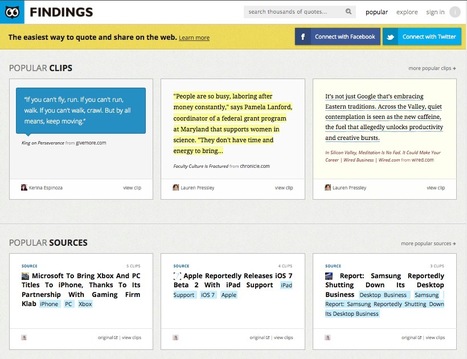
Findings allows you to curate collections of quotes on topics of interest to you.
Sue Alexander's curator insight,
July 21, 2013 9:47 PM
I love this tool. Not only is it great for curation, the content is rich and easily serchable.
Steve Tuffill's comment,
July 16, 2013 12:23 PM
Thanks for sharing this, Robin! There are some awesome resources here!
Stephen Dale's curator insight,
July 22, 2013 6:03 AM
A useful list of website "scraping" tools. Not mentioned but should be added to the list: https://scraperwiki.com/
Begoña Iturgaitz's curator insight,
July 14, 2013 7:50 AM
Very good point from Anne- Marie. It's also useful for thinking on what you filter....
David Álvarez's curator insight,
July 17, 2013 3:12 AM
Robin Good's insight:
Back in 2003 visionary artist Anne-Marie Schleiner wrote an inspiring paper entitled "Fluidities and Oppositions among Curators, Filter Feeders and Future Artists" describing the future role of online curators as nature's own filter feeders.
Anne-Marie is clearly referring to curators to and filter feeder in art world, but her rightful intuitions are equivalently applicable to the larger world of information, data, digital and content curation as well.
But let me explain better.
First. The term "filter feeders" is used in nature to describe a group of animals which thrives on its ability to filter organic matter floating around them.
From Wikipedia: "Filter feeders are animals that feed by straining suspended matter and food particles from water, typically by passing the water over a specialized filtering structure.
Some animals that use this method of feeding areclams, krill, sponges, baleen whales, and many fish(including some sharks). Some birds, such as flamingos, are also filter feeders.
Filter feeders can play an important role in clarifying water, and are therefore consideredecosystem engineers."
From Wikipedia: "In marine environments, filter feeders and plankton are ecosystem engineers because they alter turbidity and light penetration, controlling the depth at which photosynthesis can occur.[4]"
Second. If you re-read this last sentence slowly and look at what it could mean if applied to the field of content curation, it would read to me something like this:
"In large information ecosystems like the web, filter feeders/content curators and content itself are ecosystem engineers because they:
a) directly influence our ability to inform ourselves effectively and to discern truth from false and useless info (turbidity)
b) shed light and clarity on different subjects which would otherwise remain obscure (light penetration)
c) determine our ability to make sense of our own generated information streams (photosynthesis)."
A very inspiring parallel indeed, giving a way to visualize the true importance and role that curation, disenfranchised from the confines of museums and art galleries, could have on the planetary information ecosystem.
Anne-Marie writes: "Most web sites contain hyperlinks to other sites, distributed throughout the site or in a "favorites" section.
Each of these favorite links sections serves as a kind of gallery, remapping other web sites as its own contents.
Every web site owner is thus a curator and a cultural critic, creating chains of meaning through association, comparison and juxtaposition, parts or whole of which can in turn serve as fodder for another web site's "gallery."
Site maintainers become operational filter feeders, feeding of other filter feeders sites and filtering others' sites.
Links are contextualized, interpreted and "filtered" through criticism and comments about them, and also by placement in the topology of a site.
The deeper a link is buried, the harder it may be to find, the closer to the surface and the frontpage, the more prominent it becomes, as any web designer can attest to.
I am what I link to and what I am shifts over time as I link to different sites...
...
In the process, I invest my identity in my collection - I become how I filter."
Anne-Marie vision (2003), pure and uninfluenced by what we have seen emerge in the last few years, paints a very inspiring picture of the true role of content curators and of the key responsibility they do hold for humanity's future.
Inspiring. Visionary. Right on the mark. 10/10
Original PDF: http://opensorcery.net/opposition.pdf
wanderingsalsero's curator insight,
July 12, 2013 10:50 PM
An obvious 'must have' for anybody who's open minded and curious about different kinds of music.
Carlos H's curator insight,
November 4, 2013 4:29 PM
Music curation is in the future of music and allows producers and artist the oppotunity of touching their fan base. Wtih music curation you as an artist allow your fans to tell you what they want to hear, this allows the industry to filter out the one hit wonder who linger s around and makes way for the true talents to do what they love.
wanderingsalsero's curator insight,
July 12, 2013 10:54 PM
Seems to me this could be used to make some great content for blogs...and the link could be used as Facebook content.
Greg Longmuir's curator insight,
July 16, 2013 12:55 PM
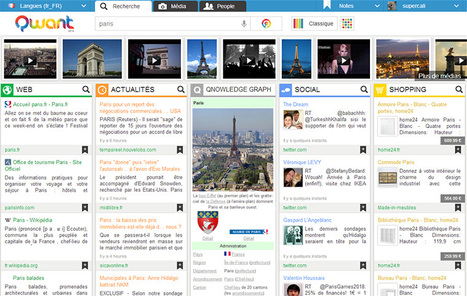
I guess you can never have enough curating, in this digital age anything that can keep you up to date and help visibility is worth a try. I like the way the simplify everything. I'm not sure but even with all this info I still may feel like I'm missing something and go to the individual sites anyway. But to see what the landscape looks like in a quick view Qwant is pretty cool.
Alfredo Corell's curator insight,
July 17, 2013 2:09 PM
A new meta-search engine... deserves a visit
Kathy Schrock's curator insight,
January 23, 2014 7:00 PM
Librarians have been doing this for years, but now have many tools to pick from!
Angel Somers's curator insight,
February 2, 2014 1:31 PM
LIbrarians are natural curators! It's what we do, so it makes sense that we should take the initiative to promot curation as a valuable skill for both our colleagues and our students.
Thomas C. Thompson's curator insight,
July 7, 2013 10:48 PM
People were born to learn, this makes everyone they're own expert in the topic they love best.
Asil's comment,
August 3, 2013 8:33 PM
The Internet Archive has been a leader on this since the inception of the Internet. They have a subscription service called Archive-It and you can share access to those perma-links using their WayBack Machine. Here's the link to that site: https://archive.org/web/web.php
Robin Good's comment,
August 4, 2013 1:33 AM
Asil, thank you so much for this very appropriate reminder.
blogbrevity's comment,
August 5, 2013 9:20 AM
Great opportunity to explain the difference! Permamarks is a "hybrid" way to save links, and the basic version is free. Permamarks creates ONE link that is BOTH a bookmark and an archive at the point of time YOU viewed it: http://pmrks.com/cronut-for-saving-links. When you share a permamark, it provides content in the "context" of when you viewed it. That is what makes Permamarks so valuable for scooping. It preserves a link to a current "realtime" page, but if that page has been removed or changed, you automatically have an archived version at the point in time you captured it. Your scoop.it pages stay relevant and free of dead links. This is very different from other archiving or caching services you can go back to and research pages or links archived at "their" point in time (which may be different from "your" point in time.) Robin, this reminds me of when I first defined curation as different from aggregation because curation presented a "point of view." This is so important to curation. Now an individual can save the internet from their own "point of view." Thank you, again, for this great post and discussions.
|
Alfredo Corell's curator insight,
July 27, 2013 4:05 PM
As it stands: curate, review, find, and discover Educational Apps
Rick Bessey's curator insight,
August 15, 2013 8:46 AM
More a place holder for now. Haven't read the article, but looks promising.
Roberto Ivan Ramirez's comment,
August 15, 2013 8:56 PM
herramientas para aprender a curar información aplicadas al ámbito escolar, bastante recomendable esta práctica.
ghbrett's curator insight,
July 18, 2013 9:08 AM
This is another post where I recommend that you scroll down to have a look at Robin Good's great commentary. I can not beat his for details. His Scoop.it site is: http://curation.masternewmedia.org/ Thanks Robin!
Jenifer Rettler's curator insight,
July 18, 2013 10:15 AM
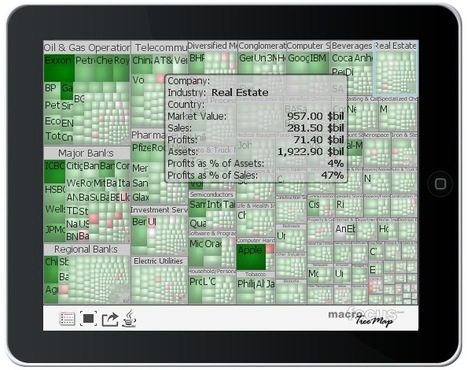
If you are looking for additional visualization tools for displaying data, TreeMap v. 3.0 offers a classic tree map layout as well as others, like squarified variant, circular, tag cloud and voronoi.
terrymc's curator insight,
September 23, 2013 10:21 AM
Curation can be used as an authentic activity with many disciplines to enable students to critically evaluate resources for a common interest. Would like to hear more about discipline based projects.
Karyn McGinley's curator insight,
October 22, 2013 7:13 PM
I am eager to delve into this further....
Robin Martin's comment,
July 15, 2013 3:34 PM
Absolutely Deb! I'm also sharing Robin's insights in my circles...great article and thanks for sharing, Robin!
Kaye Blum's curator insight,
July 16, 2013 5:55 AM
Better than Scoop.it? It has the advantage of highlighting text... other advantages?
SLRE's curator insight,
August 2, 2013 6:45 AM
Handig app om dingen die je op het web tegenkomt van aantekeningen te voorzien en te bewaren.
wanderingsalsero's curator insight,
October 20, 2013 7:54 PM
I haven't read this article but I'm seriously interested in the question implied in the title.....i.e. how to 'mark up' information and get them on the web. In many cases, I think that's adequate for most people's purpose.
I have yet to find a tool that I found really comfortable for doing that. Maybe this is it.
Adam Donkus's comment,
July 12, 2013 9:44 AM
Sweet..I have been using the free script from Google, which is lacking in a lot in the visual department..I will be checking it out..thanks for sharing..
Alex Grech's curator insight,
August 9, 2013 11:35 AM
My current absorption with Pearltrees started with an exploration of Robin Good's incredible structure. To be studied, admired and shared.
Ashish Rishi's curator insight,
July 4, 2013 11:49 PM
Love you Marco!!! Agreed and couldn't have asked for more. Internet to me was the ultimate democratization tool , a leveler, a ground playing field that challenged all institutions that had unnecessary walls around them - say educational institutions , you loved them, but they were for a fortunate few. Internet platforms ( including google) were formed for the love of internet, they have milked it enough and why not ? but now these guys are trying to become to old school walled gardens, I just hope that in doing so , they don't lose the charm that defines them.
Laura Brown's comment,
July 6, 2013 2:43 PM
This is like the AOL model of the Internet which they offered years ago. People thought they were online but they were only online via AOL which mean AOL controlled what they say, how they saw it, etc. Many people were fine with the AOL version of the Internet. People who just wanted to look at email and use chat forums for personal reason and put up a personal home page, etc. However, the people who did not like being restricted or confined choose to opt out of AOL and use other ISP's (Internet Service Providers). I'm not surprised Google wants to take several steps back and go that way, take control of what people are allowed to see and make sure the ads are featured versus having the option to block them. They have already gone several steps backwards in bringing back pop up ads. No one seems to protest those, or the video and other bulky ads which take up a lot of bandwidth. People had a large voice against all that when it was still the artists, scientists and other geeks who ruled online. Now it is the marketers and the Internet reflects the change in a big way. It's like one big ad soup. Google just wants to tie it all up in a neat bundle.
Catherine Smyth's curator insight,
July 8, 2013 10:59 PM
Links to a range of applications for content curation of topics.
Henrik Safegaard - Cloneartist's curator insight,
July 6, 2013 8:50 AM
The app that makes it easy to create, share and subscribe to personalized video channels. Add your favorite videos from across the web with just one tap.
People are always looking for new ways to express themselves, especially online, and Rockpack provides a unique way for users to do so. |
This site will be a hit with my students! Can't wait to plant some "trees".