Content Curation World
1.0M views | +24 today
Content Curation World
What a Content Curator Needs To Know: How, Tools, Issues and Strategy
Curated by Robin Good
Author: Robin Good   Google+
Your new post is loading...
Scooped by Robin Good
October 29, 2013 12:25 PM
Scoop.it!

Content Curation and Preservation: How To Archive Digital Documents Reliably

Content Curation and Preservation: How To Archive Digital Documents Reliably | Content Curation World | Scoop.it
Robin Good's insight:


John Bell, web developer, PhD student and lecturer at the University of Maine has published a useful cheat sheet synthesizing the best file formats to work with, provide access to, and to permanently archive digital artworks. 


The visual guide provides archival file format references for text, audio, video and image contents as well as suggestions for ideal formats to use also for both working and for providing accessing to such digital contents.


Useful. Handy. Informative. 8/10


Original article: http://www.hastac.org/blogs/belljo/2013/10/28/digital-documentation-art-workshop-and-fighting-bit-rot 


Cheat Sheet (PDF): http://novomancy.org/john/digital_archiving_cheat_sheet_mica.pdf 


Stephen Dale's curator insight, October 29, 2013 1:38 PM

A useful guide to the art of digital archiving.

ghbrett's curator insight, October 29, 2013 8:08 PM

Be sure to check out Robin Good's comments below.

Alfredo Corell's curator insight, November 2, 2013 8:38 PM

Interesting post about archieving digital documents in a realiable way

Scooped by Robin Good
October 26, 2013 1:19 PM
Scoop.it!

From News as Reporting To News as a Gateway To Learn In Depth About a Topic

From News as Reporting To News as a Gateway To Learn In Depth About a Topic | Content Curation World | Scoop.it
Robin Good's insight:


It's the second time that I go back to this insightful article by Jonathan Stray, dating back to 2011, but which was visionary and rightful then as it is still now. The first time I did, right after it came out, I didn't actually realize in full how relevant and important was the idea being communicated through it.


On the surface the article talks about an hypotethical Editorial Search Engine as a desirable news app. But if you look just beyond the surface, which is by itself fascinating, in essence, Mr. Stray indicates how useful and effective it would be if news publishers moved on from reporting and into 100% curated coverage of a certain topic, issue or story, opening a fascinating discovery gateway around each story and allowing in time for these streams to intersect and interconnect with each other.


By doing this, we can not only make the news much more interesting and relevant, but we can transform them into instruments for in-depth learning about anything we are interested in.


In this light the future of news could be very much about Comprehensively Informing an Audience on a Specific Topic. And if you stop enough time to re-read it and think about it, this is a pretty powerful and revolutionary concept by itself.


He specifically writes: "Rather than (always, only) writing stories, we should be trying to solve the problem of comprehensively informing the user on a particular topic."


"Choose a topic and start with traditional reporting, content creation, in-house explainers and multimedia stories. Then integrate a story-specific search engine that gathers together absolutely everything else that can be gathered on that topic, and applies whatever niche filtering, social curation, visualization, interaction and communication techniques are most appropriate."


Jonathan Stray makes also a very inspiring connection to Jay Rosen of NYU and his idea of covering 100% of a story which in my view correctly anticipated the niche content curation trend while going beyond it in its effort to explore gateways to innovation. 

.

.

.

Insightful. Visionary. Inspiring. 9/10

.

.

.
.
Michael Britt's comment, October 27, 2013 12:27 PM
I think the points above are excellent. I only wish "content consumers" if you will, agreed with this message. I say that because I have been critisized by one consumer because he didn't feel that I gave him ENOUGH content on a topic. In other words, in many content consumer's minds, A LOT OF CONTENT = VALUE. Hopefully the public is going to realize that this is not true.
Stephen Dale's curator insight, October 29, 2013 1:56 PM

A useful article on the  role of journalists by Jonathan Stray. He postulates that rather than writing stories, journalists should be trying to solve the problem of comprehensively informing the user on a particular topic, by applying filtering, social curation, visualistion and interaction with their audience. I think the professional press has woken up to this, and commend the Guardian for their insightful reporting. 

Scooped by Robin Good
October 18, 2013 8:16 AM
Scoop.it!

Is Your Content Curation Truly Useful or Is It Just a Marketing Tactic?

Is Your Content Curation Truly Useful or Is It Just a Marketing Tactic? | Content Curation World | Scoop.it
Robin Good's insight:


Here is the idea: "The drive for offering ‘more’ is not always the best path.


It does not always create something unique. It does not always better serve a target audience. It does not always differentiate you from the competition. It does not always offer something that can’t be found elsewhere. It does not always solve a problem, or fulfill a desire."


Collecting and regurgitating all of the news that "appear" to be relevant may not be such a great idea after all.


"With unlimited server space and free distribution, the temptation can be too great to share AS MUCH content as possible, with the theory that they are better serving the many sub-niches of their market. In other words, you may often see less curation, and more collection."

I don't know if I'd be so generous to label "collection" this uncontrolled regurgitation of content with little real vetting and verification (let alone curation), but Dan Blank, has an interesting story about curation and collectors that I woud not hesitate to recommend reading.


There are some good insights in it.


One of them rings like this: "...collecting behavior is to collect AS MUCH of something as possible, and not curate or edit their collection at all.


Indeed I see many supposed curators doing exactly this.


Because, as Dan writes correctly "...with unlimited bandwidth and free distribution channels with digital media, it can be sooooo tempting to post more and more content, aimed at more and more target markets.


Plus, the temptation to seem as large as possible, and to give Google as much content as possible to crawl for all of those searches."


But there's a lot more valuable stuff and insight to get by reading in full the original story (even if it was written in 2010).


Insightful. Truthful. 8/10


Full article: http://wegrowmedia.com/digital-publishing-curation-vs-collection-vs-experience/ 


(Image credit: Robin Good)


Mariale Peñalosa Arguijo's curator insight, October 18, 2013 10:41 PM

add your insight...

 10
Thorsten Strauss's curator insight, October 19, 2013 4:43 AM

Good questions but I think digital curation has different dynamics and also purposes. What do you think?

Scooped by Robin Good
October 14, 2013 7:37 AM
Scoop.it!

Preservation: Make a Permanent Archive Copy of Any Webpage with Mummify.it

Preservation: Make a Permanent Archive Copy of Any Webpage with Mummify.it | Content Curation World | Scoop.it
Robin Good's insight:


After Permamarks and Perma.cc have made their recent debut, there is a new free web service offering the ability to store, preserve and index any web page.


Mummify.it it's very simple to use. You can either paste the URL of a web page that you want to be preserved or you can install the Mummify bookmarklet and click on it anytime you are on a web page that you want to archive forever "as is".


Mummify creates a "permanent", in the cloud, non-movable and supposedly non-changeable link to the archived version of your selected page. (I say supposedly because of course no-one can really guarantee for the future of this company yet.)


From then on you can share directly the mummified URL (or a shortened version of it), as, until the "original" is live and accessible online, it will point directly to it. Only if the "original" goes down, the mummified URL will re-direct automatically to the "preserved" copy.


A free version allows you to archive up to 10 pages per month. The $10/mo plan allows for 25 and the $15/mo plan provides also analytics and alerts for when the "original" of any archived page goes down.


My comment: Mummify represents an unstoppable and useful trend inherited by curation disciplines that have a much longer history than "content curation": preservation. Mummify.it, like its two predecessors is a useful tool, that will become even more appreciated when fully integrated (as Buffer does) into any professional content curation tool. 


Free for most.


Try it out now: https://www.mummify.it 


(Image credit: Golden birdwing by Shutterstock)


Louise Robinson-Lay's curator insight, October 15, 2013 3:30 AM

Sometimes you need an archive of a site. Gret for slow bandwidth areas when you just want to show an aspect of a site. Here is how.

Stephen Dale's curator insight, October 15, 2013 7:30 AM

A useful addition to the digital curator's toolkit.

Alfredo Corell's curator insight, November 3, 2013 9:24 AM

When you Mummify a webpage—a news article, blog post, photo or tweet, for example— we make a permanent copy and back it up in the cloud. We then give you a new URL that looks like this: http://mummify.it/2452862


Mummify is free up to 100 mummies a month. If you need to Mummify more than 100 pages in a given month you can purchase 50 more for $5.
Scooped by Robin Good
October 9, 2013 5:29 PM
Scoop.it!

Why Crowdsourcing Future Is Moving To Curation, Synthesis and Things

Why Crowdsourcing Future Is Moving To Curation, Synthesis and Things | Content Curation World | Scoop.it
Robin Good's insight:


Gaurav Mishra does an excellent job in explaining and illustrating in greater depth the concepts and ideas introduced in his presentation: Future of Crowdsourcing: Creation to Curation, Search to Synthesis, Content to Things.


The key axiom in the article is that crowdsourcing is slowly shifting: 

a) in terms of input: from creation to curation,

b) in terms of output: from search to synthesis, and

c) in terms of focus: from content to things.


For example when it comes to input, we are moving from crowdsourcing platforms that helped us to create logos or simple graphic designs to new services that will actually curate for us the best design candidates to take into consideration.


A great enlightnening example of this shift, can be seen by looking at one of the many excellent resources listed in this article: ImageBrief, an online service which connects creatives with photographers, who themselves handpick images from their hard disks to match the criteria listed in the submitted creative briefs. 


My comment: Gaurav comprehensive vision and ability to spot relevant shifts and trends is not only uncanny, but also systematic. No matter which article or presentation you look at in his collection you can be sure to find something always of value. 


Excellent. Insightful. Resourceful. 9/10


Full article: http://gauravonomics.com/future-crowdsourcing-trends/ 


kitty de bruin's curator insight, October 25, 2013 4:15 AM

co creating, such a nice way to work together

María Dolores Díaz Noguera's curator insight, November 16, 2013 8:13 AM

Great one.

irene's curator insight, January 10, 2014 9:16 AM

Perché il futuro del Crowdsourcing va in direzione della cura, sintesi e cose varie.

Scooped by Robin Good
October 12, 2013 1:31 PM
Scoop.it!

Search, Collect, Organize and Publish Video Collections on Your Site with Huzzaz

Search, Collect, Organize and Publish Video Collections on Your Site with Huzzaz | Content Curation World | Scoop.it
A new way to collect, organize, discover, and watch the best videos on the web.
Robin Good's insight:


Huzzaz is a new free video curation web service which allows you to search, find, collect and publish video clip collections on whataver topic or theme you may be interested in.


An internal search engine makes it easy to search for clips across YouTube and Vimeo, and to add them selectively to one of your collections. A bookmarklet is also available to clip videos that you find while surfing.


Video collections can be easily shared on social media or embedded easily on WordPress, Tumblr or on any other web site. 


Free to use.


My comment: Promising alternative to the many options out there. Very easy to use both as a discovery tool as well as a video curation tool. Will need to see how it develops.


Get an invite here: http://huzzaz.com/beta


Review by SocialTimes: http://socialtimes.com/huzzaz-makes-it-easy-to-create-and-share-video-playlists_b136571


*Added to Video Curation Tools section of the Content Curation Tools Supermap


Asil's curator insight, October 12, 2013 4:38 PM

According to the site, they have the ability to strip the ads off the videos you put on your lists.  Makes me wonder how YouTube and Vimeo will react once they realize they aren't getting ad-views.  And if there are no ad-views, how the makers will feel about the loss of revenue?

The founder is James Yang.  There's a nice article about him on Social Times: http://socialtimes.com/huzzaz-makes-it-easy-to-create-and-share-video-playlists_b136571

From the article: Huzzaz is a passion project. “I just want to create something that helps make the world a better place.”

Alfredo Corell's curator insight, October 13, 2013 2:32 PM

video curation tools

in beta-version

free to register have a go!!!

Gianfranco Marini's curator insight, October 15, 2013 3:28 AM

Mi limito a tradurre all'impronta la recensione di Robin Good


Huzzaz è un servizio web based per la video curation che consente di ricercare, filtrare, organizzare e pubblicare raccolte di clip video su un tema specifico.


Grazie a un motore di ricerca è semplice trovere clip su Uoytube e Vimeo e aggiungerle a una delle nsotre collezioni. Grazie a un bookmarklet è anche possibile aggiungere immediatamente contenuti video che troviamo durante la navigazione.


Le collezioni video realizzate possono essere facilmente condivise nei principali social network o incorporate.


Molte facile da utilizzare, Huzzaz è un utile strumento per scoprire video e per la video curation


LINK UTILI

http://huzzaz.com/beta per ottenere un invito per registrarsi su Huzzaz

Scooped by Robin Good
October 8, 2013 4:55 PM
Scoop.it!

The Five Laws of The Content Curation Economy by Steve Rosenbaum

The Five Laws of The Content Curation Economy by Steve Rosenbaum | Content Curation World | Scoop.it
Robin Good's insight:


Steve Rosenbaum (the author of Curation Nation) strikes some pretty powerful chords that fully resonate with my vision and expectations about the future of content curation.


On the assumption that "The speed, scale, and number of distinct elements of produced content will double every 24 months." (call it Rosenbaum law) he rightly asserts that, as if there was already enough content, we are going to be literally inundated by tons of it soon.


In this light content curation is much more than what content marketing providers would have you think (save some time and get more interesting content out). Content curation is rather a socially critical activity that will make it possible for people to learn, find the information they need and indpendently evaluate what product to buy.


Steve Rosenbaum outlines five principles around which the economy of content curation will establish itself. They are:


The First Law: People don’t want more content, they want less. 


The Second Law: Curators come in three shapes... 


The Third Law: Curation isn’t a hobby, it’s both a profession and a calling. Curators need to be paid...


The Fourth Law: Curation requires technology and tools to find, filter, and validate content...


The Fifth Law: Curation within narrow, focused, high-quality categories will emerge to compete with...


My comment: Steve Rosenbaum is right on track with this one and his five principles are 100% correct. If you are into content curation for the long ride, read them again.


Rightful. On track. 9/10


Full article: http://www.thevideoink.com/features/voices/the-coming-age-of-the-curation-economy-building-context-around-content/ 


Scooped by Robin Good
October 7, 2013 1:25 PM
Scoop.it!

Curated Shopping: eBay To Introduce Curation Features This Fall

Curated Shopping: eBay To Introduce Curation Features This Fall | Content Curation World | Scoop.it

eBay hired a Chief Curator from Bureau of Trade and will be introducing new social features to the site this fall, including Pinterest-like collections and Facebook-like follow buttons. Take a look in our exclusive sneak peek.

Robin Good's insight:


According to Ina Steiner on eCommerceBytes.com eBay has hired Michael Phillips Moskowitz to act as Chief Curator and Editorial Director and will be launching in the coming weeks its own curated collections features.


To see some of the upcoming curation features that eBay is going to offer to facilitate recommendations and trusted shopping among eBay 120 million active users, go and check out http://www.ebay.com/usr/ohjoystudio who is likely a beta user having already access to them.


"On her eBay Profile page, you can see her collections presented in very much the style of Pinterest boards."


Curated shopping collections are a powerful trust-enhancing method to help buyers share their know-how while helping others make more informed choices. eBay is only one among many other large online e-shops (Etsy and Amazon have both recently introduced similar features) to make curation features available to its users.


Interesting. Informative. 7/10


Full article: http://www.ecommercebytes.com/cab/abn/y13/m10/i01/s01 


DSDomination's curator insight, November 7, 2013 5:36 AM

Start your own dropshipping business on eBay! Find out how at http:///www.AuctionDropship.com #ebay #dropshipping #makemoneyonline

Scooped by Robin Good
October 3, 2013 1:22 PM
Scoop.it!

The Museum of Online Museums: A Curated Catalogue of Fantastic Web Collections

The Museum of Online Museums: A Curated Catalogue of Fantastic Web Collections | Content Curation World | Scoop.it
Robin Good's insight:


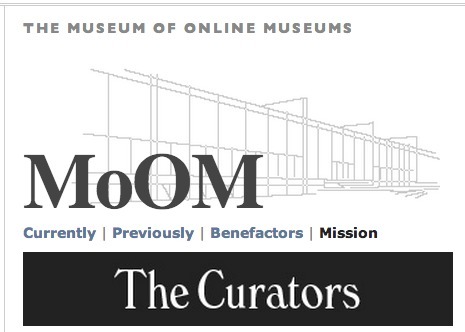
The Museum of Online Museums is an online project showcasing a growing catalogue of the most interesting digital museums and online collections of all kinds.


The site provides access to three main curated sets:


1) The Museum Campus presenting a short list of to brick-and-mortar museums with an interesting online presence.


2) The Permanent Collection which offers a second short list of online collections of particular interest to design and advertising.


3) Galleries, Exhibitions and Shows where you can find an infinite number of unique digital collections of all kinds. "...an eclectic and ever-changing list of interesting links to collections and galleries, most of them hosted on personal web pages."


The richness and variety of the digital collections included is amazing and covering the most unthinkable subjects: from grocery list collections to antique tuning dials you probably can find your own addictive corner. 


Free to use.


Check it out now: http://coudal.com/moom/index.php 


Check "The Curators" clip: http://coudal.com/moom/curators1.php 


Françoise Grave's curator insight, October 16, 2013 2:04 PM

Des ressources en anglais mais un impressionnant catalogue.

Mary Reilley Clark's curator insight, October 25, 2013 10:25 AM

I love browsing museum collections online, and this site has links to some amazing ones I hadn't seen before.

Catalina Elena Oyarzún Albarracín's comment, May 7, 2014 4:02 PM
Great post,thanks fr sharing!!!
Scooped by Robin Good
October 1, 2013 1:05 PM
Scoop.it!

Content Curation as a New Form of Journalism

Robin Good's insight:


Federico Guerrini, an Italian freelance journalist is the author of a new research study done for the University of Oxford and sponsored by Thomson Reuters which analyzes the emergent use of content curation practices for journalistic use.


The research provides a good introduction to content curation, and a few excellent examples of how it has been used effectively for journalistic purposes. 


Excerpt: "Without giving up their traditional skills, journalists are becoming more and more information “managers”.  They are behaving like human filters which due to the absence of boundaries (i.e. space limitations, like television's airtime or newspapers’ pages) typical of the digital world, verify and add context to what user-generated content they think to be relevant, and feed it onto Web pages or mobile applications."


The paper also covers the convergence of curation and storytelling, curation tools and the opportunities that may arise for media organizations and independent professionals in the near future. 


The closing sentence remarks what has also been my main concern since I have been experimenting and learning my curation approach: "...

we have to hope that these new players don't choose to fall on the wrong side of the line, taking advantage of the new possibilities offered by curation tools just to transform them into propagandistic platforms." (I read this to mean "exclusively into content marketing tools used for creating more noise". 


PDF study: https://reutersinstitute.politics.ox.ac.uk/fileadmin/documents/Publications/fellows__papers/2012-2013/Newsroom_Curators___Independent_Storytellers_-_content_curation_as_a_new_form_of_journalism.pdf 


review by Reuters Institute: https://reutersinstitute.politics.ox.ac.uk/about/news/item/article/newsroom-curators-and-independent-s.html 


Federico Guerrini's comment, October 2, 2013 5:06 AM
Actually, I believe it will become more and more important, as an issue, as newsrooms cut staff, especially foreign correspondents
socialNONmente's curator insight, October 2, 2013 6:54 AM

La "Content Curation" è una nuova forma di giornalismo? Se lo è  chiesto un giornalista freelance italiano specializzato in tecnologia, Federico Guerrini, in una ricerca commissionata dal Reuters Institute for the Study of Journalism 

https://reutersinstitute.politics.ox.ac.uk/about/news/item/article/newsroom-curators-and-independent-s.html

David Sallinen (WAN-IFRA)'s curator insight, October 3, 2013 4:48 PM

newsroom curators to engage readers !

Scooped by Robin Good
September 28, 2013 11:16 AM
Scoop.it!

Content Curation for Learning and Development: What People Think [Video]


Robin Good's insight:


Over a year ago, Ben Betts has curated a nice video clip trying to bring together different viewpoints and takes on what content curation is and how it can be used effectively for learning and development. 


The clip which is seven minutes long includes several written statements from individuals as well as a set of short front-face video explanations on the value of curation. 


The result is a unique video, which without fancy effects or glamourous introductions, which dives right into the topic by bringing together valuable viewpoints in a format that is effective for anyone wanting to slowly learn and discover what this curation frenzy is all about.


Good job. For those interested in education and development interested in learning more about curation. 7/10


Original video: http://youtu.be/DEN-QRrilS4 


Event page where it was first published: http://curationcamp.eventbrite.co.uk/# 


Ben Betts: http://www.twitter.com/bbetts 


Rudi Permana's curator insight, September 29, 2013 11:14 AM

I started to enjoy this new activity

Begoña Iturgaitz's comment, September 29, 2013 5:43 PM
many thanks!!!
Begoña Iturgaitz's curator insight, September 29, 2013 5:52 PM

Nora goaz? 

Scooped by Robin Good
September 25, 2013 12:39 PM
Scoop.it!

Content Curation: an Introductory Guide by Sadie Baxter

Content Curation: an Introductory Guide by Sadie Baxter | Content Curation World | Scoop.it
Robin Good's insight:


Sadie Baxter has published an excellent introductory guide to content curation in which she explains in clear and simple words.


  • what curation is, and is not
  • which are its benefits
  • the steps needed
  • tips
  • tools


If you are new to content curation and want to get the basics well explained into just one article, this is a good one to check.


Rightful. Comprehensive. 8/10


Full guide: http://thecontentauthority.com/blog/what-is-content-curation


Klaas Joosten's curator insight, September 30, 2013 4:22 PM

We can use these steps for our to become experts !

enrique rubio royo's curator insight, October 20, 2013 1:44 PM

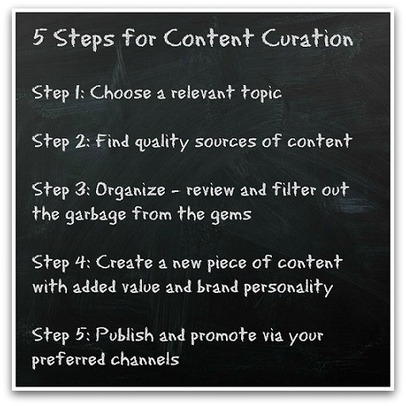
Sencilla y útil exposición del proceso de curación de contenidos (excelente síntesis la de la imagen), incluyendo recursos y herramientas que lo facilitan en cuanto al coste temporal requerido en toda curación de contenidos.

Marisol Araya Fonseca's curator insight, February 1, 2014 12:04 PM

Nice guide

Scooped by Robin Good
September 24, 2013 8:30 AM
Scoop.it!

Content Curation: How To Add Value - 6 Alternative Approaches

Content Curation: How To Add Value - 6 Alternative Approaches | Content Curation World | Scoop.it
Content curation is a great tactic for promoting your thought leadership — but only if the audience can clearly distinguish your insight from that of your source material. Use these 6 strategies to...
Robin Good's insight:


Pawan Deshpande outlines, explains and illustrates with real examples six different approaches that you can use to add value to your content curation efforts. 


He outlines how to:

  • Abstract
  • Summarize
  • Quote
  • Retitle
  • Storyboard
  • Parallelize


My comment: Excellent resource for content marketers wanting to move up one level the level of their curation, from simple republishing to value-added selection.


Useful. Educational. Resourceful. 7/10


Full article: http://contentmarketinginstitute.com/2013/09/content-curation-add-value-commentary/ 


(Image credit: Add button by Shutterstock)


Randy Bauer's curator insight, September 25, 2013 9:53 AM

Adding value to content curation with 6 Alternative Approaches gives a detailed, example based look at the How to Strategies to ContCuration.


I am interested, as a newbie, to look deeper into the platform of Storify after reading this article. 


Check out the great example on Jeff Bezos.

Marcelo Santos's curator insight, September 27, 2013 10:22 AM

This is a meta-content-curation-comment, since I am commenting an article on the importance of commenting articles on content curation! Ha!

Marcelo Santos's curator insight, September 27, 2013 10:23 AM

Curadoria de Conteúdo editada, comentada.

Scooped by Robin Good
October 28, 2013 11:17 AM
Scoop.it!

Content Curation: 13 Sense-Making Approaches To Add Value To Information

Content Curation: 13 Sense-Making Approaches To Add Value To Information | Content Curation World | Scoop.it
Robin Good's insight:


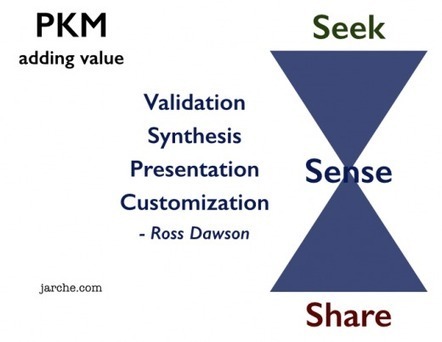
According to Harold Jarche, knowledge is an emergent property of all sense-making activities.


Curation and PKM (personal knowledge management) have the same objective: helping oneself and others gain more understanding about whatever we are interested in. The only difference between the two is that curation devotes itself to satisfy the knowledge needs of an audience while the second addresses these at a personal level.


But what are sense-making activites about?


Harold Jarche draws on Ross Dawson's five ways of adding value to information as well as on Nancy Dixon examination Rob Cross and Lee Sproull examination of tacit knowledge sharing practices inside large organizations to identify at least eight individual approaches to sense-making or adding more value to existing information.


These include:


  1. Validating
  2. Synthesizing
  3. Presenting
  4. Customizing

  5.  Answering
  6. Meta-informing
  7. Reformulating
  8. Legitimizing

    to which I would personally add:
     
  9. Comparing
  10. Finding related items
  11. Illustrating - Visualizing
  12. Evaluating
  13. Crediting and attributing


It is indeed around identifying and becoming aware of these specific aspects of our sense-making activities that we can improve and augment our capability to learn and to effectively curate information for others.


Thoughtful. Inspiring. 8/10


Original post: http://www.jarche.com/2013/10/pushing-and-pulling-tacit-knowledge/ 


Maria Persson's curator insight, October 30, 2013 6:03 PM

This is definately something that anyone in the coming new century needs to learn how to do effectively.  Do we want regurgitation or depth of learning from knowledge gained?   I value, for example, how Scoop.it allows for the 'web interface' to be looked after, by them ,and the curation and learning happens with us!


Thanks for sharing this Robin Good!

ManufacturingStories's curator insight, October 31, 2013 12:54 PM

Robin's insights always bring content to the next level!

Michelle Ockers's curator insight, June 30, 2014 5:00 PM

Article lists a range of ways to use sense-making to add value to curated content.

Scooped by Robin Good
October 24, 2013 3:44 PM
Scoop.it!

Curate Browsable Web Page Collections with Nextly

Curate Browsable Web Page Collections with Nextly | Content Curation World | Scoop.it
Browse hand-picked collections of webpages and curate your own.
Robin Good's insight:


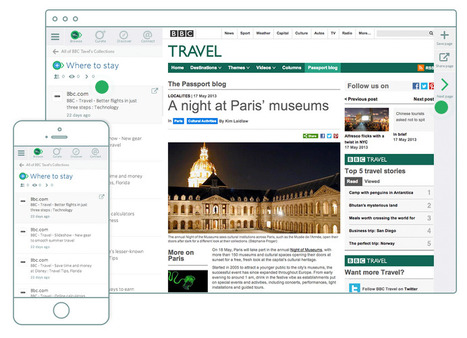
Nextly is a free web app which allows you to create collections of web pages that can be easily navigated as a tour on any device. 


Via the integrated Add Page feature or the accompanying bookmarklet you can add just about any web page to one of your collections, as well as content coming from Twitter, Facebook or RSS feeds and other social media.


A unique characterizing feature of Nextly is that the content of a collection gets pre-loaded when accessed by a user, making the browsing through elements of the collection quite fast. 


When browsing through a Nextly collection all original web pages are reproduced as they appear on the web, and are rapidly pre-fecthed to provide a faster loading experience.


My comment: Potentially a valuable content curation tool to organize specific sets of articles and distribute them in a format that is effective ad easy to access. It can be used also as an effective new reader and news discovery tool.


Free to use. 


Try it out now: http://nextly.com/ 


Sample collection: http://nextly.com/hackernews 


Review: http://pandodaily.com/2013/10/24/nextlys-curated-browser-provides-an-alternative-to-scammy-news-readers/  


Carlos Bisbal's curator insight, October 24, 2013 5:06 PM

Crea colecciones de páginas Web navegables con Nextly


Nextly es una aplicación web gratuita que te permite crear colecciones de páginas web por las que puedes navegar de forma fácil como si realizaras un tour en cualquier dispositivo.

Es potencialmente una valiosa herramienta de curaduría de contenidos para organizar conjuntos específicos de artículos y distribuirlos en un formato que es eficaz y de fácil acceso. También se puede utilizar como un nuevo lector eficaz y como herramienta de descubrimiento de prensa y contenidos.

wanderingsalsero's curator insight, October 24, 2013 10:23 PM

I'm going to have to investigate this further to see how practical it REALLY is.  It seems like every week there's something else like this that comes out. 


One thing that occurs to me thought:  I wonder if it would be possible to use this or tools like it, to create sellable content...some new type of curated content ebook?

Alfredo Corell's curator insight, November 3, 2013 8:37 AM

Free 


An example:


http://nextly.com/hackernews ;


In the news:

The New York TimesTechmemehttp://pandodaily.com/2013/10/24/nextlys-curated-browser-provides-an-alternative-to-scammy-news-readers/  ;

Scooped by Robin Good
October 15, 2013 1:27 PM
Scoop.it!

Content Curation: Understanding the Why and How - a Research Study

Robin Good's insight:


Changtao Zhong, Karthik Sundaravadivelan and Nishanth Sastry from King's London College and Sunil Shah from Last.fm have published a research study entitled: "Sharing the Loves: Understanding the How and Why of Online Content Curation".


The study (9 pages) analyzes the behaviour of thousands of individuals pinning images on Pinterest and liking and categorizing songs on Last.fm and reveals a few interesting insights:


a) what people curate as relevant is not generally among the top ranked results according to popular metrics. Good stuff is not the same as what is considered normally popular or authoritative stuff.


b) content curation allows a community to synchronize around specific issues and subjects (as anticipated by Clay Shirky)


c) better and more appreciated curation is of the "structured" kind, providing additional info, meta-data and categorization.


d) curators that are highly appreciated are characterized by consistent activity and by a variety of interests (or viewpoints under the same theme) that they are capable to cover.


My comment: Valuable insight into the essential traits of curation emerge from this interesting study of two popular content sharing and curation sites. In my eyes it highlights how inevitable is that curation will gradually match and replace search and what successful curators need to do to become more visible.


Original PDF: http://www.inf.kcl.ac.uk/staff/nrs/pubs/icwsm13.pdf 



Deanna Dahlsad's curator insight, October 15, 2013 3:59 PM

Robin Good  of Content Curation World breaks the findings down thus:


a) what people curate as relevant is not generally among the top ranked results according to popular metrics. Good stuff is not the same as what is considered normally popular or authoritative stuff.


b) content curation allows a community to synchronize around specific issues and subjects (as anticipated by Clay Shirky)


c) better and more appreciated curation is of the "structured" kind, providing additional info, meta-data and categorization.


d) curators that are highly appreciated are characterized by consistent activity and by a variety of interests (or viewpoints under the same theme) that they are capable to cover.


This is rather my experience; however, I usually explain it to my clients this way:


a) You can be doing an excellent job, but never receive the recognition, popularity, or traffic you deserve.That doesn't mean you won't be appreciated greatly by the smaller group of people who do find/read your curated works.


b) No matter the popularity of your curation, you can build and have conversations -- but remember, community cultivation not only requires additional time, but a different skill set.


c) If you're going to do it, do it well. Use tools, such as labels and tags, and *always* provide context as well as proper credits and links.


d) Consistent activity is nearly as important as showing some personality along with your knowledge. Your topic may be narrowly focused, but offer additional topics and information about you personally (not just professionally) so that people get a sense of you.

Carmenne Kalyaniwala's curator insight, October 16, 2013 2:17 AM

A research paper by Zhong, Shah, Sundaravadivelan and Sastry, King's college London, 2013

AnneMarie Cunningham's curator insight, October 17, 2013 8:28 AM

See the excellent notes from Robin Good below. Interesting to see more work emerging in this field.

Scooped by Robin Good
October 13, 2013 1:11 PM
Scoop.it!

Need To Explain Content Curation To Someone Else? Here Are 5 Special Resources

Need To Explain Content Curation To Someone Else? Here Are 5 Special Resources | Content Curation World | Scoop.it
Robin Good's insight:


Introducing content curation to someone who doesn't know anything about it is not always an easy task.


There are so many different articles, opinions, definitions and recommendations about content curation that it is quite difficult for someone just getting familiar with the topic, to easily find out where to start and what to trust.


To help out anyone needing to support the explanation of content curation to others, here are five comprehensive resource collections I have put together over the course of the last year. 


1) Content Curation - Definitions

a collection of the best and most useful definitions
of what content curation is

http://bundlr.com/b/content-curation-definition  


2) Content Curation - What is it? Video Intros

30+ short video clips that introduce the need,

practice and purpose of content curation 

http://huzzaz.com/collection/content-curation-what-is-it 


3) Content Curation Visualized 

110+ infographics, visuals, illustrations and diagrams explaining what content curation is 

www.pinterest.com/robingood/content-curation-visualized/ 


4) Content Curation Tools Directory - Tools Directory 

100+ of the best content curation tools organized

in a directory for immediate access

http://contentcuration.zeef.com/ 


5) Content Curation Tools Supermap - Tools Collection

600+ content curation, discovery, filtering and publishing tools organized by categories for doing content curation

http://bit.ly/ContentCurationToolsSupermap 


All free to use and share.


Gianfranco Marini's curator insight, October 26, 2013 11:37 PM

Traduco liberamente la recensione di Robin Good dall'inglese.  


Spiegare cosa sia la content curation - cura dei contenuti a qualcuno che non lo sa non è semplice dato che vi sono molte definizioni, articoli, concezioni e interpretazioni che la riguardano.


Per offire un aiuto a chi avesse necessità di spiegare la content curation sono qui presentati 5 gruppi di risorse:


1) Content Curation - Definizioni

raccolta delle migliori definizioni di content curation

http://bundlr.com/b/content-curation-definition


2) Content Curation -video

30 brevi clips video che introducono alla content curation

http://huzzaz.com/collection/content-curation-what-is-it


3) Content Curation - infografiche 

oltre 110 infografiche che spiegano cosa sia la content curation

http://www.pinterest.com/robingood/content-curation-visualized/


4) Content Curation - strumenti

oltre 100 tra i migliori strumenti per la content curation

http://contentcuration.zeef.com/


5) Mappa sugli strumenti per la content Curation - collezione di strumenti

più di 600 strumenti per la content curation (organizzazione pubblicazione, categorizzazione, scoperta, ecc)

http://bit.ly/ContentCurationToolsSupermap


Leah Lesley Christensen's curator insight, December 2, 2013 1:37 PM

Never heard of it - must be worth sharing :)

Robin Good's insight:Introducing content curation to someone who doesn't know anything about it is not always an easy task. There are so many different articles, opinions, definitions and recommendations about content curation that it is quite difficult for someone just getting familiar with the topic, to easily find out where to start and what to trust. To help out anyone needing to support the explanation of content curation to others, here are five comprehensive resource collections I have put together over the course of the last year. 1) Content Curation - Definitions a collection of the best and most useful definitions of what content curation is http://bundlr.com/b/content-curation-definition 2) Content Curation - What is it? Video Intros 30+ short video clips that introduce the need, practice and purpose of content curation http://huzzaz.com/collection/content-curation-what-is-it 3) Content Curation Visualized 110+ infographics, visuals, illustrations and diagrams explaining what content curation is www.pinterest.com/robingood/content-curation-visualized/ 4) Content Curation Tools Directory - Tools Directory 100+ of the best content curation tools organized in a directory for immediate access http://contentcuration.zeef.com/ 5) Content Curation Tools Supermap - Tools Collection 600+ content curation, discovery, filtering and publishing tools organized by categories for doing content curation http://bit.ly/ContentCurationToolsSupermap All free to use and share.
Maria Richards's curator insight, March 29, 2014 4:50 PM

This link is invaluable to support an understanding of content curation. 

Scooped by Robin Good
October 13, 2013 5:49 AM
Scoop.it!

The Curated Google Search Result Page: The Mega-SERP

The Curated Google Search Result Page: The Mega-SERP | Content Curation World | Scoop.it
Robin Good's insight:


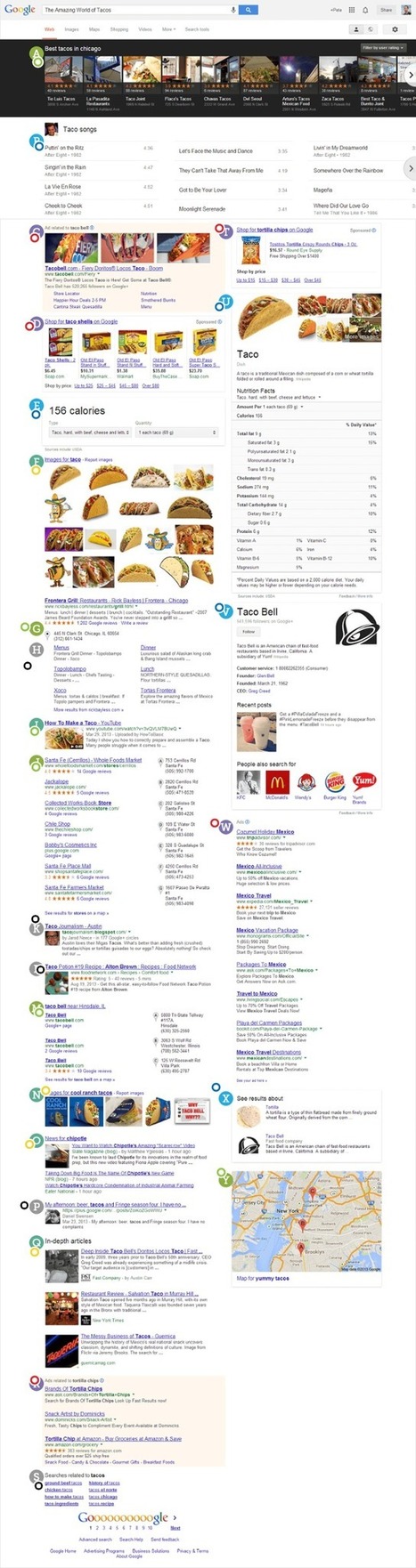
A good example of how you can provide a lot more insight to others by painstakingly curating a specific topic by collecting, organizing and juxtaposing effectively all of the relevant pieces.


Dr.Pete. also known as Peter J. Myers has curated an insightful visual montage that showcases all of Google search engine result page features in one page.


The result is a pretty amazing view, that, at least in my view, would be much more welcome than the existing results. Much more so, if it was me, the user searching, being able to decide which one of these features to turn on or off depending on my needs.


The time has come for me and you to decide how we want to slice, view and rank search results and this wonderful user-generated montage points to how much more could be seen if it was me or you to decide what to display inside your SERPs.


Inspiring. Instructional. Informative. 9/10


Original story: 

http://moz.com/blog/mega-serp-a-visual-guide-to-google 


Interactive illustrated image: http://www.thinglink.com/scene/444884388539269122

*hover your mouse on the different sections to see a descriptio of that feature


Halina Ostańkowicz-Bazan's curator insight, October 20, 2013 5:45 AM

Thank you for sharing.

Lila Hanft's curator insight, October 30, 2013 3:25 PM

This could be really useful for documenting successful SEO or for setting benchmarks.

Scooped by Robin Good
October 9, 2013 1:48 PM
Scoop.it!

Best Tools for Fact-Checking, Vetting and Verifying News Online: Verification Junkie

Best Tools for Fact-Checking, Vetting and Verifying News Online: Verification Junkie | Content Curation World | Scoop.it
Robin Good's insight:


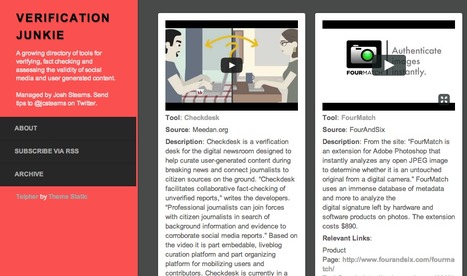
Verification Junkie is an excellent free online resource curating the most relevant tools for fact-checking and verification of online content.


"A growing directory of tools for verifying, fact checking and assessing the validity of social media and user generated content."


For each tool collected, Josh Stearns has provided a detailed description, and relevant links.


My comment: Verification Junkie is a great resource I would recommend to anyone writing or publishing online as well as a great example of an effective curated tools collection.


Excellent resource. A must go to for online journalists. 8/10


Link: http://verificationjunkie.com/ 


See also: http://verificationjunkie.com/about 


Alessandro Mazzoli's curator insight, October 9, 2013 5:30 PM

Risorsa utile ( e gratuita) per il Fact-Checking

William A Richardson's curator insight, October 21, 2013 9:48 AM

General useful tools?

Ruveanna Hambrick's curator insight, October 2, 2014 2:53 PM

This has great resources and has different multi-media links that are great for crap-detecting.

Scooped by Robin Good
October 7, 2013 3:37 PM
Scoop.it!

Attribution, Linking and Plagiarism Prevention Tips for Online Journalists

Robin Good's insight:


"Plagiarism is a firing offense. Don't: a) lift passages from other sources without attribution and link..." This is what read the first slide of a presentation deck published a few days back by Steve Buttry which goes on to list all of the situations where it's possible to run the risk of being accused of plagiarism,.


The presentation is an outline of tips for online journalists who have to deal daily with adding link references, providing credit and attribution and avoiding being accused of plagiarism.


Good advice not to be taken lightly.


Useful. 8/10


Original slide deck: http://www.slideshare.net/stevebuttry/attribution-workshop


Rob Schneider's curator insight, October 8, 2013 4:34 AM

Sharing because it's so important. I realized how important it was after forgetting to attribute a source to a photo. Plagiarism just plain sucks on all levels, but overlooking source attribution is bad manners at best.

FrancoisMagnan's curator insight, October 8, 2013 5:32 AM

Des conseils pour éviter le plagiat destinés aus journalistes comme à tous ceux qui écrivent régulièrement en ligne. Un rappel de bonnes pratiques.

Carlos Bisbal's curator insight, October 8, 2013 9:08 AM

Presentación en Slide publicada hace unos días por Steve Buttry que enumera todas las situaciones en las que es posible correr el riesgo de ser acusado de plagio.

La presentación es un resumen de consejos para periodistas online que tienen que lidiar a diario con la adición de enlaces de referencia, la concesión de créditos y la atribución de autoría y evitar ser acusados de plagio.

Un buen consejo que no debe tomarse a la ligera

Scooped by Robin Good
October 4, 2013 4:29 PM
Scoop.it!

Maria Popova and The Art of Curation: An Interview with the Curiosity Guide

Maria Popova and The Art of Curation: An Interview with the Curiosity Guide | Content Curation World | Scoop.it

"...I consume a lot of information across an incredibly wide spectrum of disciplines and sources, always aiming to synthesize the meaningful and connect it with something else for a larger portrait of what matters in the world."

Robin Good's insight:


Maria Popova is the editor of Brain PIckings, a unique blog site cum newsletter that curates stories and articles from the web that stimulate the mind of the curious and which provide insight into the type of culture we live in.


In an excellent 2010 interview written by Chris Allison, Maria explains what she defines as curation and how she goes about it in her every day work.

In her definition: "Brain Pickings is a highly curatorial endeavor. And the art of curation isn’t about the individual pieces of content, but about how these pieces fit together, what story they tell by being placed next to each other, and what statement the context they create makes about culture and the world at large.


Every piece of content on Brain Pickings is hand-picked for embodying the sort of cultural interestingness at the core of our curatorial vision – it’s creative, compelling and makes a meaningful contribution to the world; it offers a justification to be curious and enriches you in the process of indulging that curiosity."


Maria also provides great examples of curation at work, and explains how all of the advertising on her site is "pro bono" and fitting her objective of curating in full the reader experience. In other words, Maria curates which ads are showcased on her site by selecting those reflecting companies and products she actually believes in for free. 


She also provides a valuable, and much valid to this day, vision for the future of curation and curators. Niche specialization, is in this case, the name of the game.


Very interesting. Insightful. Resourceful. 8/10


Full interview: http://www.neboagency.com/blog/art-curation-interview-maria-popova 


Check also the Flipboard interview with Maria Popova here: http://inside.flipboard.com/2010/12/31/flipboard-favorite-2010-interview-with-maria-popova/ 


Randy Bauer's comment, October 5, 2013 1:43 PM
Thanks Robin, I am a fan of Brain Pickings. and of your curation as well.
Robin Good's comment, October 5, 2013 1:45 PM
Thank you Randy.
Brian Kirby's curator insight, October 11, 2013 4:41 PM

How to sift through large amounts of information...

Scooped by Robin Good
October 2, 2013 8:13 AM
Scoop.it!

Content Curation for Journalism: Six Characterizing Traits by Mindy McAdams

Content Curation for Journalism: Six Characterizing Traits by Mindy McAdams | Content Curation World | Scoop.it
The Latin root of the noun curator means "to care." We know the word primarily in connection with museum collections, which may make some folks think of dusty old boring things, or preserving histo...
Robin Good's insight:


If you are into understanding the real value of content curation and what are the characterizing traist that make it so valuable and unique for the future of journalism and of our collective ability to stay informed, here is an evergreen "classic" on what curation specifically entails, synthesized and outlined by the Mindy McAdams.


When it comes to content curation, her list includes seven specific characterizing traits:


  1. Selection of the best representatives
  2. Culling
  3. Provide context
  4. Arrangement of individual objects
  5. Organization of the whole
  6. Expertise
  7. Updating


Her content curation identikit is as useful, truthful and relevant today as it was was 5 years ago when it was first published.


Content curation reference. Must-read. 9/10


Full post: http://mindymcadams.com/tojou/2008/curation-and-journalists-as-curators/ 


Question to you: Five years on, today, what would you add to these traits, that in your view, fully characterizes content curation?


(Image credit: Fingerprint by Shutterstock)

Nancy White's curator insight, October 2, 2013 10:38 AM

I love the way examining curating from the perspective of other disciplines adds such richness to our definition and understanding of what it is, and what we are trying to accomplish with the act of curating. 

Amal Rafeeq's comment, October 4, 2013 12:02 PM
Well put mate :)
Scooped by Robin Good
September 30, 2013 2:13 PM
Scoop.it!

The Pinterest Publishing Guide for Authors and Media Sites [PDF]

Robin Good's insight:


An excellent reference guide for anyone looking to learn how to extract the best from Pinterest while having lots of relevant examples at hand.


Lots of usefu tips and references.


Useful. Resourceful. 8/10


Full guide: http://www.scribd.com/doc/170630453/Tips-for-writers-and-media-organizations-on-Pinterest 


jmwakasege's comment, October 1, 2013 1:20 AM
how come you always get good stuff, I real appreciate the value you bring. And for this one, it's a life saver.
Dan Aldridge's curator insight, October 1, 2013 9:58 AM

Excellent tips for journalists and writers of all stripes on how to use Pinterest.

Andy Birkitt's curator insight, October 2, 2013 4:22 AM

Another great resource

Scooped by Robin Good
September 28, 2013 7:10 AM
Scoop.it!

The Value of List-Making: Three Traits To Make Yours Stand Out From The Rest

The Value of List-Making: Three Traits To Make Yours Stand Out From The Rest | Content Curation World | Scoop.it
Robin Good's insight:


Beth Kanter, one of the key go-to-person for communication strategy when it comes to NGOs, provides a useful reminder of the value of creating lists for content marketing objectives alongside some good links to list-making examples and list-building tools. 


My comment: One thing that differentiates good "lists" from bad ones, is not often visibile by looking just at the surface.


Good lists in my view are characterized by these three traits: 


1) Short - long lists are tiring and not very useful


2) Categorized - "groups" help scanning and finding what you're looking for


3) Commented - excerpts from about pages as list item descriptions are not very useful, as what makes a real difference in a list is your insight, opinion or evaluation into why that item is in that list. 


Without these elements in fact, just about anyone can take a search tool and assemble the "Best of" whatever software category in a ridicule amount of time, while not really providing anything useful or reliable. 


That's the difference between a list and a curated list.


The list "as is" makes you work more to check and verify everything that's in the list, while the curated one saves you time in finding or reminding you rapidly what is exactly that you need.


Useful. Resourceful. 7/10


Original post: http://www.bethkanter.org/lists/ 


Prof. Hankell's curator insight, September 28, 2013 11:27 AM

Robin Good's insight:

Beth Kanter, one of the key go-to-person for communication strategy when it comes to NGOs, provides a useful reminder of the value of creating lists for content marketing objectives alongside some good links to list-making examples and list-building tools.


My comment: One thing that differentiates good "lists" from bad ones, is not often visibile by looking just at the surface.

Good lists in my view are characterized by these three traits:

1) Short - long lists are tiring and not very useful

2) Categorized - "groups" help scanning and finding what you're looking for

3) Commented - excerpts from about pages as list item descriptions are not very useful, as what makes a real difference in a list is your insight, opinion or evaluation into why that item is in that list.

Without these elements in fact, just about anyone can take a search tool and assemble the "Best of" whatever software category in a ridicule amount of time, while not really providing anything useful or reliable.

That's the difference between a list and a curated list.

The list "as is" makes you work more to check and verify everything that's in the list, while the curated one saves you time in finding or reminding you rapidly what is exactly that you need.

Beth Kanter's comment, September 28, 2013 12:47 PM
Thanks for adding your valuable insights that lead to improved curation practice.
Scooped by Robin Good
September 24, 2013 1:27 PM
Scoop.it!

Permanent Archival of Author Content Soon Possible Thanks To Harvard Perma.cc

Permanent Archival of Author Content Soon Possible Thanks To Harvard Perma.cc | Content Curation World | Scoop.it
Broken links are everywhere. Perma helps authors and journals create permanent links for citations in their published work.
Robin Good's insight:


Perma.cc is an upcoming web service that aims to help authors and journals create permanent archival copies of their online published content.


Way too often in fact, due to a multitude of reasons, not only content gets moved and relocated to new sites, becoming more difficult to find but in many others it is permanently deleted or lost.


To comfort your doubts that this is a true and tangible issue, you should check the work being carried out by Kendra AlbertLarry Lessig and Jonathan Zittrain, who are completing a study of link rot, available at http://papers.ssrn.com/abstract=2329161


Link rot is the phenomenon by which material we link to on the distributed Web vanishes or changes beyond recognition over time.


Believe it or not half of the links in all of the Supreme Court opinions, don't work anymore.


In this context "the Harvard Library Innovation Lab has pioneered a project to unite libraries so that link rot can be mitigated.  We are joined by about thirty law libraries around the world to start Perma.cc, which will allow those libraries on direction of authors and journal editors to store permanent caches of otherwise ephemeral links."


The Internet Archive has provided its powerful archiving engine to support this effort and Cloudfare its distributed CDN.


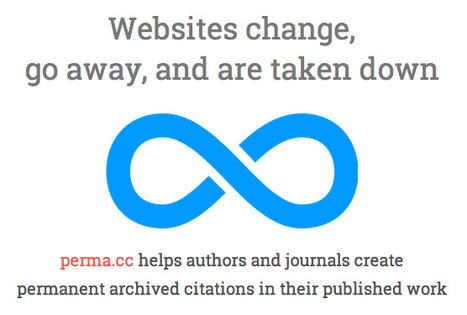
The official tagline of the upcoming site reads: "perma.cc helps authors and journals create permanent archived citations in their published work"


Here is essence what you should expect from it: "Perma.cc allows users to create citation links that will never break.


When a user creates a Perma.cc link, Perma.cc archives a copy of the referenced content, and generates a link to an unalterable hosted instance of the site.


Regardless of what may happen to the original source, if the link is later published by a journal using the Perma.cc service, the archived version will always be available through the Perma.cc link."


N.B.: While anyone will be able to go to Perma.cc and archive any web page this resource is designed for researchers, authors and journals. In this light Perma.cc downloads the material at the designated URL and provides a new URL (a “Perma.cc link”) that can then be inserted in a paper. 


After the paper has been submitted to a journal, the journal staff checks that the provided Perma.cc link actually represents the cited material. If it does, the staff “vests” the link and it is forever preserved. Links that are not “vested” will be preserved for two years, at which point the author will have the option to renew the link for another two years.


My comment: Can't wait to test it. We need these type of archival tools like oxygen. It's not only important that we organize and curate what is important from the web, but it is essential that we also take care in preserving it for the longest possible time.


Free and open to all (soon).


Request beta access here: http://perma.cc/ 


More info: http://blogs.law.harvard.edu/futureoftheinternet/2013/09/22/perma/ 


Similar Tools: www.Permamarks.com  


Blaithan Michael Altenburg's curator insight, September 24, 2013 3:11 PM

This is good that they are helping

Prof. Hankell's curator insight, September 25, 2013 10:33 AM
Robin Good's insight:


Perma.cc is an upcoming web service that aims to help authors and journals create permanent archival copies of their online published content.


Way too often in fact, due to a multitude of reasons, not only content gets moved and relocated to new sites, becoming more difficult to find but in many others it is permanently deleted or lost.


To comfort your doubts that this is a true and tangible issue, you should check the work being carried out by Kendra Albert, Larry Lessig and Jonathan Zittrain, who are completing a study of link rot, available at http://papers.ssrn.com/abstract=2329161. ;


Link rot is the phenomenon by which material we link to on the distributed Web vanishes or changes beyond recognition over time.


Believe it or not half of the links in all of the Supreme Court opinions, don't work anymore.


In this context "the Harvard Library Innovation Lab has pioneered a project to unite libraries so that link rot can be mitigated.  We are joined by about thirty law libraries around the world to start Perma.cc, which will allow those libraries on direction of authors and journal editors to store permanent caches of otherwise ephemeral links."


The Internet Archive has provided its powerful archiving engine to support this effort and Cloudfare its distributed CDN.


The official tagline of the upcoming site reads: "perma.cc helps authors and journals create permanent archived citations in their published work"


Here is essence what you should expect from it: "Perma.cc allows users to create citation links that will never break.


When a user creates a Perma.cc link, Perma.cc archives a copy of the referenced content, and generates a link to an unalterable hosted instance of the site.


Regardless of what may happen to the original source, if the link is later published by a journal using the Perma.cc service, the archived version will always be available through the Perma.cc link."


N.B.: While anyone will be able to go to Perma.cc and archive any web page this resource is designed for researchers, authors and journals. In this light Perma.cc downloads the material at the designated URL and provides a new URL (a “Perma.cc link”) that can then be inserted in a paper. 


After the paper has been submitted to a journal, the journal staff checks that the provided Perma.cc link actually represents the cited material. If it does, the staff “vests” the link and it is forever preserved. Links that are not “vested” will be preserved for two years, at which point the author will have the option to renew the link for another two years.


My comment: Can't wait to test it. We need these type of archival tools like oxygen. It's not only important that we organize and curate what is important from the web, but it is essential that we also take care in preserving it for the longest possible time.


Free and open to all (soon).


Request beta access here: http://perma.cc/ ;


More info: http://blogs.law.harvard.edu/futureoftheinternet/2013/09/22/perma/ ;


Similar Tools: www.Permamarks.com

Steve Tuffill's curator insight, September 25, 2013 11:47 AM

Essential, if the Internet is our all-time library resource...